Letting the Light In: Kitchen Extensions in Notting Hill
QUICK ANSWER: Maximising light in a kitchen extension usually comes down to four tools — rooflights, full-height glazing, a glass roof lantern, and a lightwell where a basement is involved. In Notting Hill specifically, this gets one genuine complication: on many streets within the Ladbroke, Pembridge, Norland, and Colville conservation areas, even a flush rooflight can require planning permission, which isn't true across most of London. Knowing this before designing the extension, not after, is what keeps the project on schedule.
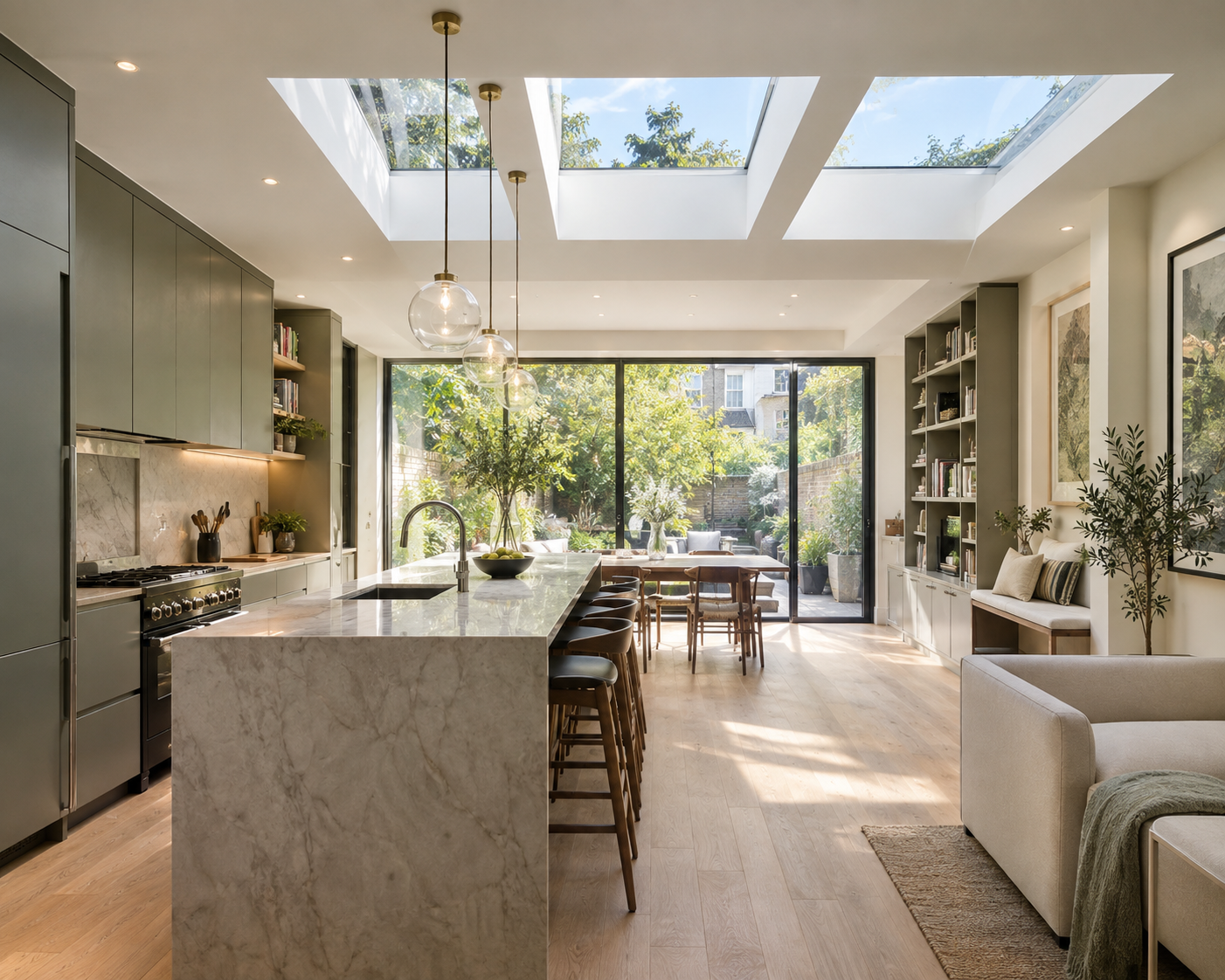
Every kitchen extension brief in London contains some version of the same sentence: "we want it to feel bright." Fair enough — a rear extension often sits at the darkest part of a Victorian terrace, boxed in by neighbouring gardens on both sides. The tools for fixing that are well established. What's less well known is that in Notting Hill, one of those tools comes with a planning catch most homeowners don't find out about until it's already a problem.
The Four Tools That Actually Bring In Light
Rooflights do more work than any other single feature, since they capture direct overhead daylight rather than the weaker, angled light a wall-mounted window gets. A well-positioned rooflight over a kitchen island can transform how a room feels through the middle of the day.
Full-height sliding or bifold glazing across the rear wall extends the sense of the garden into the kitchen itself, and brings low-angle morning and evening light deep into the room in a way a standard window never will.
Glass roof lanterns, positioned centrally over a kitchen-diner, spread light more evenly across a larger floor plan than a single rooflight, and work particularly well on wider Notting Hill extensions where one rooflight alone would leave the edges of the room in shadow.
Lightwells, where a basement is part of the project, bring daylight down to a lower ground floor kitchen that would otherwise rely entirely on artificial light — increasingly common in Notting Hill given how many properties here include a lower ground floor kitchen relocation as part of a wider renovation.
The Notting Hill Catch: Rooflights Aren't Always Permitted Development
Across most of London, a rooflight sitting flush with the existing roof slope can often proceed without planning permission, even where a full extension needs an application. Notting Hill is a genuine exception. Because Ladbroke Grove's crescents, the Pembridge streets, and the Colville and Norland areas all carry conservation area status — and RBKC layers Article 4 directions over many of these streets specifically — even a flush rooflight or a new roof covering can require an application on certain addresses.
This matters practically: a homeowner who's seen a neighbour add rooflights without any paperwork can reasonably assume the same applies to their own property, and be wrong, simply because the two houses sit on different sides of an Article 4 boundary. RBKC publishes a Conservation Area Appraisal for each of Notting Hill's designated areas, and officers apply them closely — rear-facing, flush rooflights are generally the most readily accepted form, while anything front-facing or visible from the street faces considerably more scrutiny.
What Good Design Looks Like Here
RBKC's own guidance is genuinely supportive of well-designed contemporary glazing, provided the design argument is made clearly and early — this isn't a borough reflexively opposed to light-filled extensions, it's one that wants to see the reasoning before construction starts. A well-resolved rear dormer or a considered rooflight specification, with attention to frame depth and glass quality rather than the cheapest available option, tends to fare considerably better than a scheme that treats the planning stage as an afterthought.
Frequently Asked Questions
Do I need planning permission for rooflights in Notting Hill? Often, yes — unlike most of London, many Notting Hill streets sit under Article 4 directions that remove the usual permitted development allowance for flush rooflights, on top of the conservation area status covering nearly all of W11.
How do I know if my specific property needs permission? Address-specific confirmation is essential rather than assuming based on a neighbouring property — a Lawful Development Certificate from RBKC (£274 in 2026) formally confirms whether a project is permitted development before work begins, and is worth having on file for resale.
Which brings in more light, a rooflight or a lantern? A single rooflight is more targeted and cost-effective for a smaller extension, while a lantern spreads light more evenly across a wider kitchen-diner — the right choice depends on the extension's footprint rather than one being universally better.
Planning a Light-Filled Kitchen Extension?
Dominant Construction has delivered kitchen extensions across Notting Hill and the rest of Prime Central London for over 15 years — FMB-registered, working to JCT contracts, with direct experience of RBKC's conservation area and Article 4 requirements specific to W11.
Call 020 7118 6155 for a consultation, get in touch online, or see recent projects at dominantconstruction.co.uk.