Kitchen Flooring Trends 2026 London: The Best Floors for Victorian & Modern Extensions
Quick Answer
In 2026, the best kitchen flooring balances durability, underfloor-heating performance and character. For Victorian extensions, engineered oak, stone-look porcelain and patterned tiles can respect the original house while working with a modern plan. For contemporary extensions, large-format porcelain, natural stone and resilient flooring offer practical, clean lines. The right choice starts with the floor build-up.
Why Kitchen Flooring Matters More Than It Used To
Kitchen flooring used to be treated as the final decision after the cabinets, worktops and appliances had been selected.
That approach can cause problems.
The floor affects finished floor levels, door thresholds, underfloor heating, kitchen island heights, skirting details and the transition between the original house and the extension.
In a Victorian terrace, that matters even more.
You may be connecting a narrow original kitchen to a new side return or rear extension with large areas of glazing. The flooring then becomes one of the main elements tying the two spaces together.
The good news is that 2026 flooring trends are moving away from overly clinical finishes.
Current kitchen design reporting points towards natural finishes, texture, tonal variation and warmer materials, rather than floors that look perfectly uniform.
For a period property, that is particularly useful.
The 5 Kitchen Flooring Trends Worth Considering in 2026
1. Stone-Look Porcelain
Porcelain remains one of the most practical choices for a busy kitchen.
It can reproduce limestone, slate, marble, concrete and other natural materials while offering a highly durable and relatively low-maintenance surface.
Current UK construction coverage continues to highlight porcelain for its durability, low water absorption and compatibility with underfloor heating.
For a Victorian extension, a matt stone-effect porcelain in a warm limestone or aged-stone tone can work particularly well.
It gives you the visual weight of natural stone without necessarily introducing the same maintenance requirements.
For a modern glass extension, larger-format porcelain can create a quieter floor with fewer grout lines.
Best for:
- Rear extensions
- Side returns
- Open-plan kitchens
- Underfloor heating
- Busy family kitchens
- Contemporary extensions
2. Engineered Oak Flooring
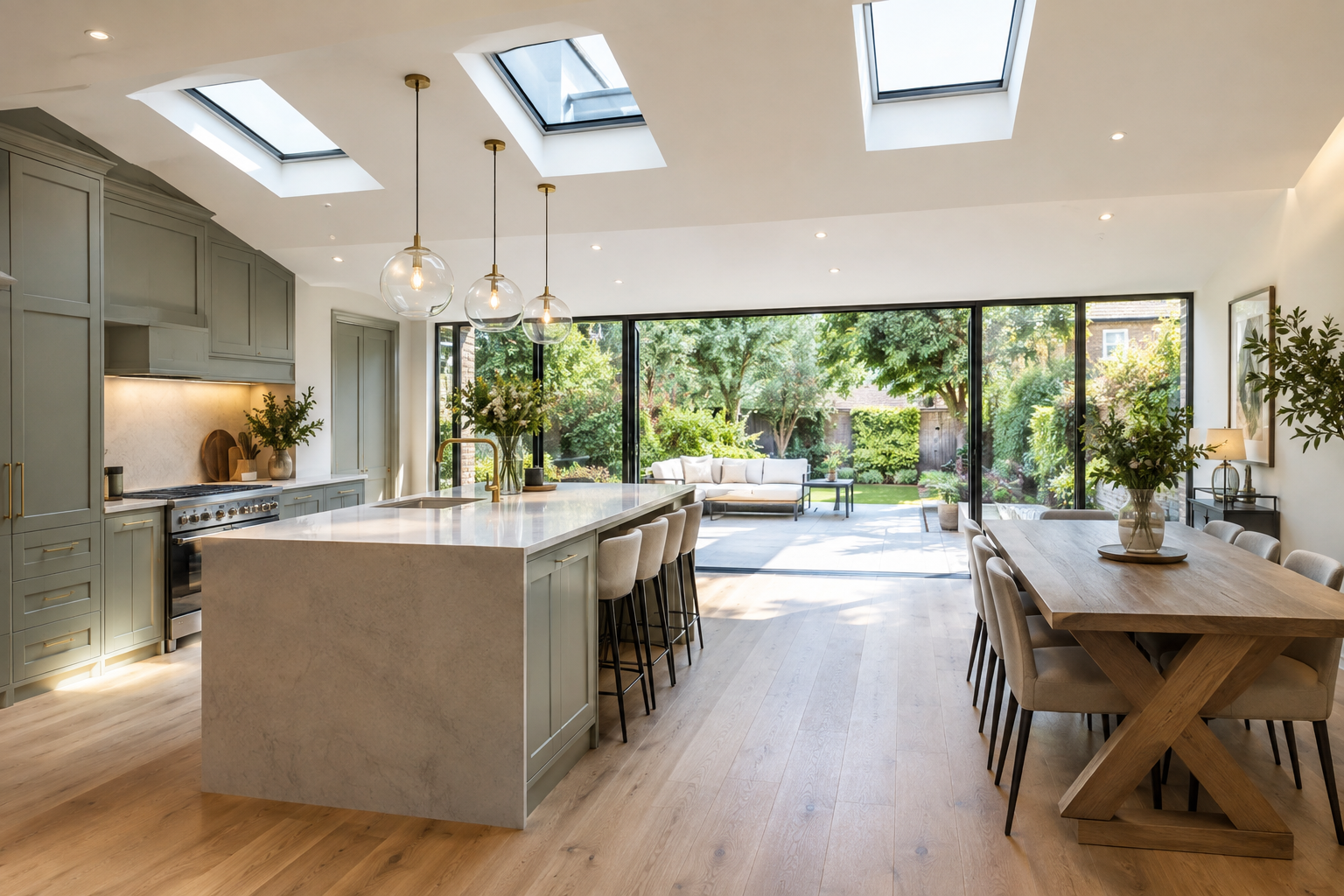
If porcelain feels too hard or contemporary, engineered oak is often the warmer alternative.
It is particularly effective where the kitchen connects directly to a dining room, family room or original reception space.
Rather than making the extension feel like a separate addition, the same timber floor can visually connect several areas of the ground floor.
Engineered timber also works particularly well in Victorian properties because it introduces warmth without pretending the new extension is original.
A wide plank, natural oak or lightly smoked finish can look considerably more considered than heavily distressed timber.
Chevron and herringbone patterns can also work, although scale matters. A small kitchen can become visually busy if the floor pattern competes with the cabinetry.
Dominant Construction's existing flooring guidance similarly recommends engineered wood where homeowners want the appearance of timber while avoiding some of the moisture-related drawbacks of solid wood.
For wider advice on integrating finishes into an extension, see our house extension services.
3. Natural Stone
Natural stone is still difficult to beat if the brief calls for a floor with genuine variation and ageing potential.
Limestone can give a kitchen a softer, architectural quality, while darker stone can create a more dramatic scheme.
The important point is that natural stone is not maintenance-free.
Depending on the material and finish, it may require sealing and ongoing care. It also needs to be considered alongside the heating strategy because stone can feel cold without underfloor heating.
In 2026, the wider design direction is towards floors with texture and natural variation rather than perfectly consistent surfaces, making stone particularly relevant.
Best for:
- Period houses
- Large kitchen extensions
- Open-plan entertaining spaces
- Projects where material ageing is part of the design
4. Terracotta — But With a Modern Twist
Terracotta is having a noticeable moment in 2026.
Traditional terracotta has warmth and irregularity that can suit older properties exceptionally well. The downside is that genuine terracotta is porous and can require more care.
A practical alternative is terracotta-effect porcelain.
Current 2026 design coverage specifically highlights terracotta-effect porcelain as a way to achieve the warm, earthy appearance while gaining greater durability and moisture resistance.
For a Victorian extension, avoid choosing the floor simply because it is "rustic".
Look for:
- muted clay tones
- subtle tonal variation
- matt finishes
- slightly irregular-looking surfaces
- restrained grout colours
The aim is character, not a country-house theme park.
5. Resilient Flooring and LVT
There is also a practical reason not to dismiss resilient flooring.
The 2026 UK Houzz Kitchen Trends Report found that vinyl/resilient tile was the most popular flooring choice among homeowners upgrading or replacing kitchen flooring, at 29%, ahead of porcelain at 15% and engineered wood at 14%.
Luxury Vinyl Tile (LVT) can be particularly useful where comfort, water resistance and ease of cleaning matter.
It can reproduce timber, stone and other finishes without requiring the same maintenance regime.
It may not be the first choice for every high-spec extension, but technically it can make very good sense in the right room.
Which Flooring Is Best for a Victorian Kitchen Extension?
There isn't one universal answer.
*Always check the flooring manufacturer's specified thermal resistance and installation requirements.
For many London projects, porcelain and engineered oak are the two options worth comparing first.
Porcelain gives you durability and thermal performance.
Engineered oak gives you warmth and continuity.
The right answer depends on the architecture.
Should the Floor Match the Original Victorian House?
Not necessarily.
One of the mistakes made in period-property renovations is trying too hard to make every new element look old.
A Victorian house can accommodate a distinctly contemporary extension.
The trick is usually proportion and material quality rather than imitation.
For example:
Original house:
Period cornicing, timber doors, sash windows and traditional detailing.
New extension:
Slim-framed glazing, contemporary kitchen cabinetry and engineered oak or large-format stone-effect porcelain.
The flooring can become the quiet connection between the two.
A good extension does not need to pretend it was built in 1895.
What About Underfloor Heating?
This decision needs to happen before the floor is installed, not after.
Underfloor heating changes the specification of the floor build-up and should be considered alongside insulation, screed depth, finished floor level and the chosen floor covering.
Porcelain and stone are particularly well suited to underfloor heating because they conduct heat effectively.
Engineered timber can also work, but the manufacturer needs to confirm suitability for the specific heating system.
This is one reason flooring should be selected during the technical design stage rather than when the project is already on site.
Our design and build service brings architectural, structural and construction considerations together before work begins.
Don't Forget the Floor Build-Up
This is the part clients rarely see — and the part that can cause expensive mistakes.
Before laying the finished floor, the project may need to account for:
- insulation
- damp protection
- structural slab
- screed
- underfloor heating
- adhesive
- tiles or timber
- thresholds
- skirting
- existing floor levels
In an older Victorian property, the existing floor may not be perfectly level either.
That means simply saying "we want large-format porcelain" is not enough.
The technical build-up has to work.
The finished floor should also meet adjoining rooms without creating awkward steps or thresholds.
Large-Format Tiles or Smaller Tiles?
Large-format porcelain can make an extension feel calm and spacious.
Fewer grout joints mean less visual interruption, particularly when the floor continues towards a large glazed opening.
However, large tiles are less forgiving of uneven substrates.
They require careful preparation and accurate installation.
Smaller patterned tiles can be more appropriate where the design deliberately references the period property.
A Victorian side return might suit a restrained geometric pattern.
A minimalist rear extension might be better served by a large-format limestone-effect porcelain.
Neither is automatically better.
The architecture should decide.
How Much Should You Budget for Kitchen Flooring?
Flooring costs vary too widely to give one meaningful figure without knowing the specification.
The actual budget can include:
- Floor preparation
- Removal of existing flooring
- Screed or substrate works
- Insulation
- Underfloor heating
- Flooring material
- Adhesive or underlay
- Installation
- Sealing, where required
- Threshold and finishing details
A £100-per-m² floor covering can therefore produce a very different installed cost depending on the condition of the existing floor.
This is particularly important when renovating a Victorian property, where subfloor preparation can become part of the project rather than an optional extra.
For wider budgeting considerations, our home renovation service covers the broader construction work that can sit around a kitchen upgrade.
The Floor Should Be Selected Before the Kitchen Is Finalised
This is one of the simplest ways to avoid problems.
Your flooring decision can affect:
- kitchen unit heights
- island dimensions
- appliance positioning
- skirting details
- door clearances
- glazing thresholds
- underfloor heating
- transitions into existing rooms
It is therefore better to select the floor as part of the overall kitchen extension specification rather than treating it as a decorative purchase at the end.
A Sensible 2026 Shortlist
If you are currently planning a Victorian or modern kitchen extension in London, I would narrow the initial shortlist to these:
For a warm Victorian look
Engineered natural oak
Particularly good where the new kitchen connects into existing reception or dining rooms.
For practical modern living
Large-format stone-effect porcelain
Durable, easy to maintain and well suited to underfloor heating.
For character
Natural limestone or another suitable stone
Best when the material itself is intended to age with the property.
For a warmer period feel
Terracotta-effect porcelain
A useful compromise between traditional character and modern practicality.
For comfort and resilience
High-quality LVT
Worth considering where maintenance and underfoot comfort are priorities.
What We Are Seeing in Kitchen Design in 2026
The broader direction is interesting.
Kitchen flooring is becoming less about creating a perfectly uniform background and more about texture, warmth and material character.
Current design coverage points towards natural-looking stone, tactile finishes and more expressive floors.
At the same time, UK renovation data shows homeowners still prioritise practical flooring materials, with resilient flooring, porcelain and engineered wood leading the choices.
That combination is probably the most useful trend of all:
good-looking floors that can actually survive a kitchen.
Because a beautiful floor that needs protecting from every dropped saucepan isn't quite the point.
Why Flooring Should Be Discussed With Your Main Contractor
Flooring looks like an interior-design decision.
In an extension, it is also a construction decision.
The contractor needs to understand the intended finish early enough to coordinate the floor levels, structural build-up, heating, drainage, thresholds and kitchen installation.
That is particularly important when an extension involves structural openings, steelwork, new foundations and the connection between an old building and new construction.
Dominant Construction has over 15 years' experience delivering extensions and renovations across London, including period and contemporary properties.
Frequently Asked Questions
What is the best flooring for a Victorian kitchen extension?
Engineered oak, porcelain and natural stone are among the strongest options. Engineered timber adds warmth and continuity, while porcelain and stone offer excellent durability and work particularly well with underfloor heating.
Is porcelain better than engineered wood in a kitchen?
Neither is universally better. Porcelain is more resistant to water and heavy kitchen use, while engineered wood provides greater warmth and continuity with adjoining living spaces. The choice should consider the property's architecture, heating system and how the kitchen connects to the rest of the house.
Can you use engineered wood with underfloor heating?
Often yes, but the specific flooring product must be approved for the heating system. The manufacturer's installation requirements, maximum floor temperature and thermal resistance should be checked before specification.
Is natural stone suitable for a kitchen extension?
Yes. Limestone and other suitable natural stones can provide a durable, characterful finish, but sealing and maintenance requirements need to be understood. Stone is also well suited to underfloor heating.
Are terracotta tiles a good choice for a Victorian kitchen?
They can be, particularly where warmth and period character are important. For easier maintenance, terracotta-effect porcelain is worth considering because it can reproduce the appearance while offering greater resistance to moisture and everyday wear.
Should kitchen flooring run through into the dining room?
Often it can. Using one flooring material through an open-plan kitchen and dining area can create a stronger sense of continuity. Alternatively, two carefully selected materials can subtly define different zones.
Planning a Kitchen Extension in London?
The floor is only one part of the specification.
The successful projects are usually the ones where structure, insulation, heating, glazing, kitchen design, flooring and finishing details are considered together from the beginning.
If you are planning a Victorian side return, rear kitchen extension or complete ground-floor renovation, speak with Dominant Construction before committing to the specification.
Dominant Construction LTD
185 Fulham Palace Road
Fulham, London W6 8QX
Phone: 020 7118 6155
Website: dominantconstruction.co.uk
You can also discuss an extension project with our team or review our completed residential projects.