QUICK ANSWER: The right balustrade depends on three things — the age and status of your property, how much light you want travelling down the stairwell, and your budget. Frameless glass is now the default choice for contemporary staircases, typically £350–£630 per linear foot. Timber spindles with a black steel handrail suit period properties. In Kensington specifically, where a large share of properties are listed, the original staircase and its balustrade are often protected as part of the building's historic character, meaning a straight swap to glass isn't always permitted.
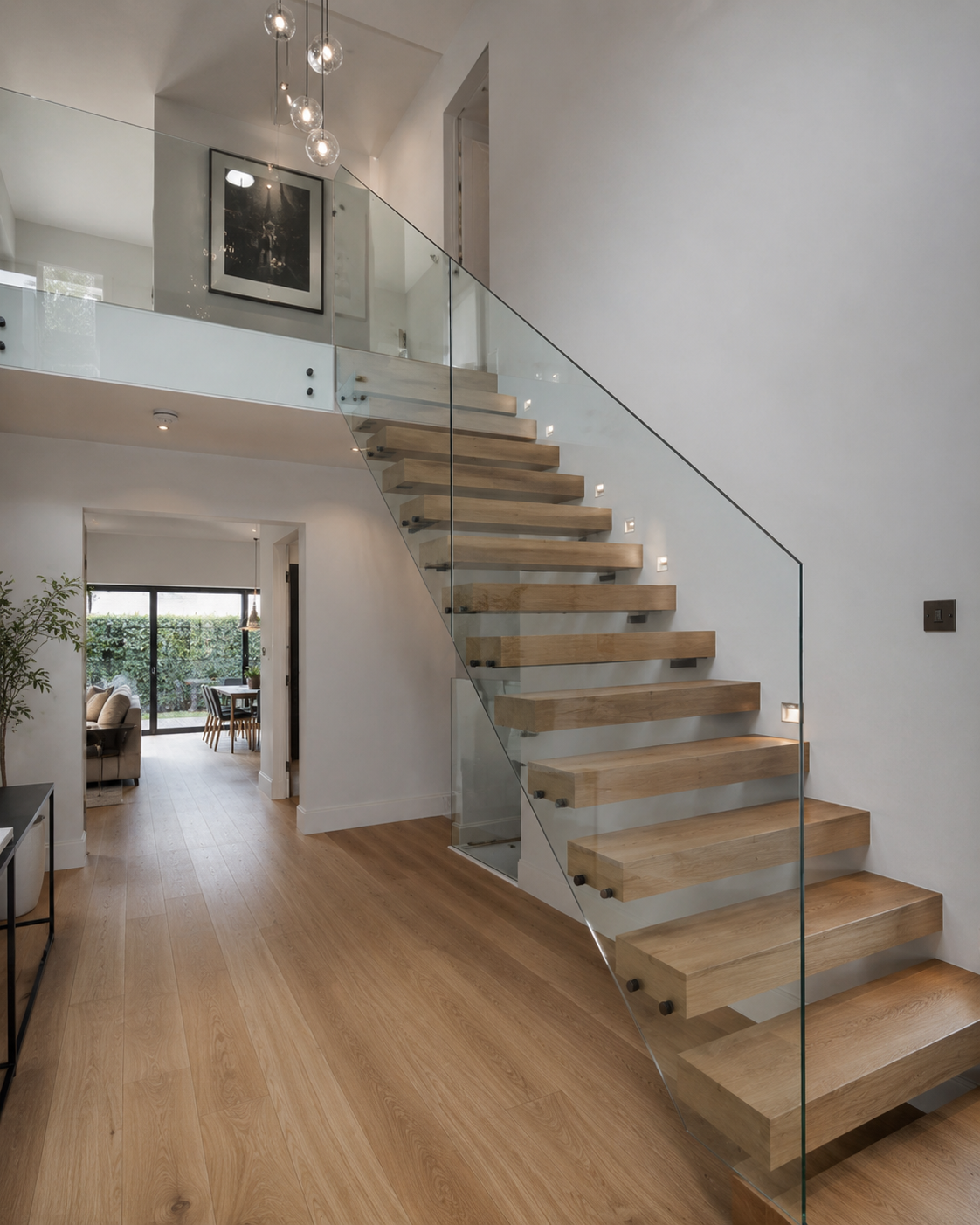
A balustrade is the one part of a staircase everyone touches and almost nobody chooses carefully. It gets treated as an afterthought — pick the treads, pick the paint colour, then grab whatever balustrade the show home had — when it's actually doing two jobs at once: keeping people from falling down the stairs, and setting the tone for the whole entrance hall every single time someone walks past it. Here's how Dominant Construction approaches the choice, and what changes if your staircase happens to sit inside a listed Kensington townhouse.
The Main Options, and What Each One Actually Says About a House
Frameless glass is the current default for contemporary London staircases, and for good reason — it lets light travel down through a stairwell that would otherwise sit in permanent shadow, particularly valuable in a narrow London terrace where every window counts. Framed and semi-frameless versions cost less and suit a slightly less minimal brief.
Steel and timber combinations — typically a black steel spine or handrail paired with solid oak treads — remain the most requested pairing for 2026, balancing warmth against precision. It reads as considered rather than trend-chasing, which matters if you'd rather the staircase still look right in a decade.
Traditional timber spindles haven't gone anywhere, and for good reason on a period property: they're often original, they're part of what makes an entrance hall feel like it belongs to the house rather than a showroom, and — as covered below — in Kensington specifically, they're frequently not yours to remove.
What This Looks Like in Kensington Specifically
Kensington's Georgian and Victorian terraces were mostly built with a consistent staircase language — turned timber spindles, a mahogany or oak handrail, sometimes ironwork on grander properties near Kensington Square or Holland Park. On a non-listed property, replacing this with a contemporary glass balustrade is generally straightforward, subject to Building Regulations for height and gap size.
On a listed Kensington property — and the borough carries a genuinely high proportion of listed housing stock — the original staircase is frequently identified as a feature of special architectural or historic interest in its own right, meaning Listed Building Consent is required before it can be altered or replaced, not just planning permission for the wider project. This catches out more homeowners than any other single detail in a Kensington renovation brief: the staircase people assumed was simply "old and needs updating" turns out to be one of the specific things the listing exists to protect.
The workable middle ground on a listed staircase is usually restoration rather than replacement — repairing original spindles, re-polishing a handrail, upgrading only what Building Regulations require — while reserving a full glass balustrade for a genuinely non-original stair, such as one added during a later basement or loft conversion where no historic fabric is at risk.
What It Actually Costs
A framed glass balustrade fitted to an existing staircase starts around £350 per linear foot, rising to roughly £450–£630 for a frameless specification. A full bespoke contemporary staircase — steel spine, oak treads, integrated glass balustrade — typically runs £9,500 to £15,000, with fully custom curved or helical designs reaching £15,000 to £35,000 or more. Restoring an original period staircase costs considerably less in most cases, though ornate ironwork or extensive timber repair on a grander Kensington property can move that figure upward.
Frequently Asked Questions
Can I fit a glass balustrade in a listed property? Sometimes, but not automatically. If the existing staircase is identified as part of the property's special historic interest, Listed Building Consent is required, and a full glass replacement is less likely to be approved than a sympathetic restoration of the original.
Is glass safer than a traditional spindle balustrade? Both meet the same Building Regulations requirements for height and gap size when correctly specified and installed — the difference is aesthetic and light-related, not a safety trade-off either way.
How long does a balustrade replacement take? A straightforward glass balustrade fitted to an existing staircase typically takes 1–2 weeks once materials arrive. A full bespoke staircase replacement, including structural work, usually runs 3–5 weeks.
Get Advice Before You Choose
Dominant Construction has advised on staircases and balustrades across Kensington and the rest of West and Central London for over 15 years — including knowing when a listed original is worth restoring rather than replacing. Call 020 7118 6155 for a consultation, get in touch online, or see recent projects at dominantconstruction.co.uk.